
French Red Wine Pairings at HOME: Five Matches from Our Cellar in Vientiane


There is a moment at HOME, most evenings, when a guest holds the wine list open at the French red page and asks us the only question that really matters: what should I drink with this?
The honest answer is that our cellar was built for our kitchen. Chef Jean-Yves Guiomar cooks French classics with Lao produce, and the reds we import — from the Médoc, Saint-Émilion, Burgundy and the Rhône — were chosen to sit next to those plates. Here are five pairings we serve every week in our garden villa in Vientiane, with the reasons behind each one. Every wine below is on our list tonight.
1. Bone-in Rib of Beef to Share × Château Beau Site 2019, Saint-Estèphe
Why it works. A one-kilo rib of beef, seared over fire and rested, is fat, char and salt. It needs a wine with tannin to cut the richness and enough backbone not to disappear behind the crust. Saint-Estèphe, the northernmost of the great Médoc villages, makes exactly that kind of wine: Cabernet Sauvignon grown on clay-heavy gravel, firmer and more savoury than its neighbours in Pauillac or Margaux. The blackcurrant and cedar in the glass pick up the smoke on the meat; the tannins soften with each bite of marbled fat.
The beef. Our rib is cut bone-in at a full kilogram, for two people or more, and finished at the table — we wrote about how it is cooked in Fire at the Table. It is carved off the bone in front of you, with the cap left on. Order it medium-rare; the bone keeps the centre gentle while the outside chars.
The wine. Château Beau Site is a Cru Bourgeois in Saint-Estèphe, on the gravel plateau near the village, from the same Castéja family that owns Château Batailley in Pauillac. The 2019 vintage was warm and dry in Bordeaux, which gives the Cabernet Sauvignon and Merlot blend ripe fruit under the classic Saint-Estèphe structure: blackcurrant, blackberry, cedar, a touch of tobacco, and a long, dry finish that keeps calling for the next slice of beef.
Bone-in Rib of Beef to Share, 1 kg — 1 650 000 K · Château Beau Site 2019 — 3 740 000 K
If you prefer Pauillac: Lions de Batailley 2014 (4 400 000 K), the second wine of Château Batailley, is older, softer and more elegant — a beautiful choice if you like your Bordeaux with a few years on it.


2. Tournedos × Château Fombrauge, Saint-Émilion Grand Cru
Why it works. Tenderloin is the most tender cut on the animal and also the leanest. Where the rib wants tannin, the tournedos wants roundness: a wine that brings the richness the meat itself does not have. That is Merlot's job. On the Right Bank of Bordeaux, in Saint-Émilion, Merlot grows on limestone and clay and gives plush, velvety wines with ripe black fruit and fine, silky tannins — the opposite of a Cabernet from the Médoc, and the perfect frame for a delicate piece of beef.
The beef. A tournedos is a thick medallion cut from the centre of the tenderloin, tied so it keeps its shape, seared hard in butter and rested. Jean-Yves serves it with a sauce of the day, and it is the dish we recommend to guests who want beef without the weight of a large cut.
The wine. Château Fombrauge is one of the largest and oldest estates in Saint-Émilion, in the commune of Saint-Christophe-des-Bardes, and has held Grand Cru Classé status since 2012. The wine is Merlot with Cabernet Franc, aged in oak: ripe black fruit, liquorice and spice, full-bodied, with the polished tannins that make Saint-Émilion so easy to love. It is the top French wine on our list, and with a tournedos it earns its place.
Tournedos — 880 000 K · Château Fombrauge — 4 510 000 K


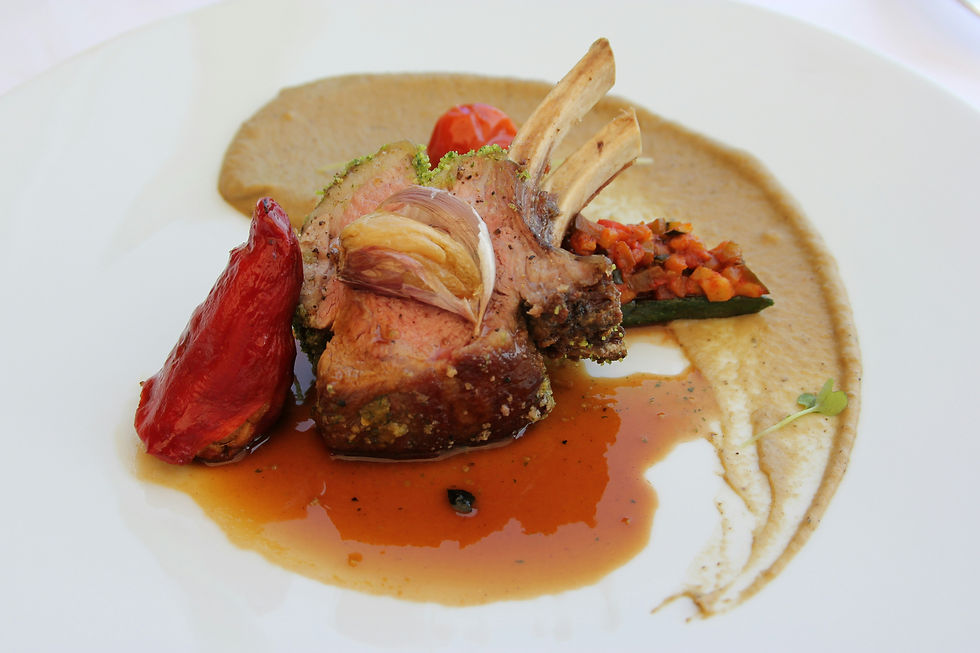
3. Lamb Rack with Pomme Duchesse × Guigal Côtes du Rhône 2019
Why it works. Lamb and the Rhône Valley is one of the oldest pairings in France, and it comes down to herbs. Syrah and Grenache grown in the southern sun carry notes of black pepper, garrigue and dried thyme that echo the way lamb is seasoned in the south of France. The wine has enough fruit to match the sweetness of the meat and enough spice to cut its richness, without the heavy tannin that would fight a pink, delicate rack.
The lamb. We roast a French-trimmed rack — the bones cleaned, the eye of the loin left whole — and carve it into chops at the pass. It comes with pomme duchesse, potato purée piped and baked until the edges are golden. This is the plate we bring out for anniversaries and for guests who want the most classic French main on the menu.
The wine. E. Guigal is the reference house of the northern Rhône, based at the Château d'Ampuis in the Côte-Rôtie, founded by Étienne Guigal in 1946 and run today by the third generation. Their Côtes du Rhône is the most widely poured red in French bistros for a reason: a blend of Syrah, Grenache and Mourvèdre, medium-bodied, with red berries, blackberry and gentle spice, smooth tannins and a clean finish. The 2019 is drinking beautifully now.
Lamb Rack with Pomme Duchesse — 1 210 000 K · Guigal Côtes du Rhône 2019 — 1 760 000 K

4. Duck Breast × Louis Jadot Bourgogne "Couvent des Jacobins" 2015
Why it works. Duck and Pinot Noir is the pairing every sommelier learns first. Duck breast served pink is rich but not heavy, with a layer of rendered fat under crisp skin. Pinot Noir has bright acidity, fine tannin and red-fruit aromatics — cherry, raspberry, a little earth — that lift the fat rather than fighting it. Anything bigger would bury the bird; anything lighter would be lost under it.
The duck. We score the skin, render it slowly fat-side down until it is glass-crisp, then finish the breast in the oven and rest it before slicing. It is served rosé, sliced on the bias, with a jus or a fruit reduction depending on the season.
The wine. Maison Louis Jadot has been in Beaune since 1859 and is one of the great négociant houses of Burgundy. "Couvent des Jacobins" takes its name from the former Jacobin convent in the centre of Beaune whose cellars the house once used. The 2015 vintage was one of the finest in a generation in Burgundy: this is an elegant Pinot Noir with ripe red berries, violet and subtle spice, smooth and generous on the palate, with the fresh finish that makes the pairing sing.
Duck Breast — 418 000 K · Louis Jadot Bourgogne "Couvent des Jacobins" 2015 — 1 760 000 K


5. Duck Leg Confit × Château Croix Saint André 2021, Lalande-de-Pomerol
Why it works. Confit is the south-west of France on a plate: a duck leg cured in salt, cooked slowly in its own fat until the meat falls off the bone, then crisped. It is deeply savoury and unashamedly rich. The Right Bank of Bordeaux, and Pomerol's neighbour Lalande-de-Pomerol in particular, makes Merlot-based wines that are round, plummy and generous — enough fruit and body to stand up to the confit, with the soft tannins that let the crisp skin and the tender meat stay the centre of attention.
The duck. Our confit is made in-house over two days. The legs are salted overnight with garlic and thyme, rinsed, then cooked submerged in duck fat at a low temperature for hours. Before serving, the skin is crisped in a hot pan. It is one of the most ordered dishes at HOME, at lunch and at dinner.
The wine. Château Croix Saint André is a family estate in Lalande-de-Pomerol, the appellation just across the Barbanne stream from Pomerol itself, where Merlot and Cabernet Franc give wines in the Pomerol style at a fraction of the price. The 2021 is smooth and charming, with ripe red fruit and subtle oak, full-bodied and silky — true to the appellation, and a natural partner for anything cooked in duck fat.
Duck Leg Confit — 286 000 K · Château Croix Saint André 2021 — 1 540 000 K


A note on the rest of the list
These five are our house recommendations, not rules. Our French red list also carries a Pessac-Léognan (Château de Rochemorin), a Haut-Médoc (L'Étoile de Villegeorge 2018), two more Saint-Émilions and a range of Bordeaux under 1 100 000 K, plus a Côtes du Rhône Villages and a Bordeaux by the glass. Ask your server, or ask for Jean-Yves — he will happily change your mind.
HOME is open Monday to Saturday for lunch (last kitchen order 14:00) and dinner (last kitchen order 21:30), and closed on Sundays. Book a table at home-vte.com or on WhatsApp at +856 20 5632 6515.
HOME — French Restaurant, Hom 10, Ban Watnak, Sisattanak, Vientiane.


Comments